What Is Maltitol?
Sugar Free Chocolate and Maltitol: What You Need to Know
If you’ve been on a quest for sugar-free chocolate, you’ve read a lot of labels — and you’ve almost certainly encountered maltitol.
It appears on ingredient lists so consistently — often listed first, meaning it’s the primary ingredient — that it has essentially become the default sweetener for mainstream “no sugar added” confections. Understanding what maltitol actually is, and why it occupies that position, is worth your time.
What’s Actually in the Candy Aisle
We took a look at the ingredient lists of some of the most recognizable sugar-free chocolate products — the ones you’ll find in any drugstore or grocery store, prominently placed near checkout, on end-caps, and in diabetes-adjacent wellness aisles.
The pattern is hard to miss.
Across major candy brands and boxed chocolate companies with decades of brand recognition, maltitol appears not just as an ingredient but almost always as the first ingredient. It’s frequently accompanied by maltitol syrup as a second or third ingredient — meaning you may be consuming two forms of the same compound from a single product.
That’s worth pausing on.
What Maltitol Actually Is
Maltitol is a sugar alcohol — a class of carbohydrates made by putting a starch-derived sugar through a chemical conversion process — close enough to sugar to taste sweet, different enough to be labeled otherwise.
Sugar alcohols as a category include erythritol, xylitol, sorbitol, and lactitol, among others. They were developed in part because they are partially absorbed by the body, which means they contribute fewer calories and, in some cases, a lower glycemic response than table sugar.
Maltitol, however, is the outlier in this group in an important way.
Does Maltitol Raise Blood Sugar? What Labels Don’t Mention
Most sugar alcohols are absorbed minimally by the small intestine. Maltitol is different: it is absorbed significantly — roughly 50% — which gives it a glycemic index estimated between 35 and 52, depending on the source. For context, table sugar has a glycemic index of approximately 65.
That gap is smaller than it looks on a label. A food marketed as “sugar-free” that derives most of its sweetness from maltitol is not the same as a food with a negligible glycemic impact. It is more accurately described as lower sugar impact — a meaningful distinction for anyone making careful choices about how their food affects their blood sugar.
The American Diabetes Association and other nutrition authorities have noted that sugar alcohols, and maltitol specifically, should still be counted in carbohydrate intake calculations.
Sugar-free is not the same as glycemic-free.
More content like this, delivered to your inbox.
SubscribeThe Digestive Side of the Story
Because maltitol is only partially absorbed in the small intestine, the remainder passes into the large intestine, where it is fermented by gut bacteria. For many people, this can produce familiar symptoms: bloating, gas, cramping, and in higher amounts, a laxative effect.
The FDA requires a laxative warning on products in which a “reasonable daily intake” of a sugar alcohol could produce these effects, though thresholds and enforcement are inconsistent across products.
The irony is real: products containing sugar alcohols and designed as a healthier alternative can cause significant digestive discomfort.
For those managing candida, maltitol presents a particular concern. Because it is partially absorbed and partially fermented in the gut, it can feed the same bacterial and fungal overgrowth that candida protocols are designed to reduce. Most candida-aware resources recommend avoiding maltitol entirely.
Sugar-free doesn’t always mean side-effect-free.
Why Manufacturers Choose It Anyway
This isn’t a mystery. Maltitol has properties that make it exceptionally convenient for large-scale production: it behaves very similarly to sucrose in baking and candy-making — it melts, sets, and coats in familiar ways that many other sweeteners don’t replicate.
From a manufacturer’s standpoint, it qualifies for “sugar-free” labeling with minimal reformulation. From a consumer standpoint, the product tastes recognizably like the original. The tradeoff — glycemic impact and digestive effects — is absorbed by the person eating it.
What to Look For on a Label
When evaluating any sugar-free or reduced-sugar chocolate product, a few things are worth checking:
Is it sweetened with maltitol? Depending on your sensitivity, that answer alone may tell you everything you need to know — maltitol carries an estimated glycemic index of 35–52, compared to approximately 65 for table sugar.
Is maltitol listed first? Ingredients appear in descending order by weight. First position means it’s the dominant ingredient.
Does maltitol syrup also appear? Two forms of the same compound compound the effect.
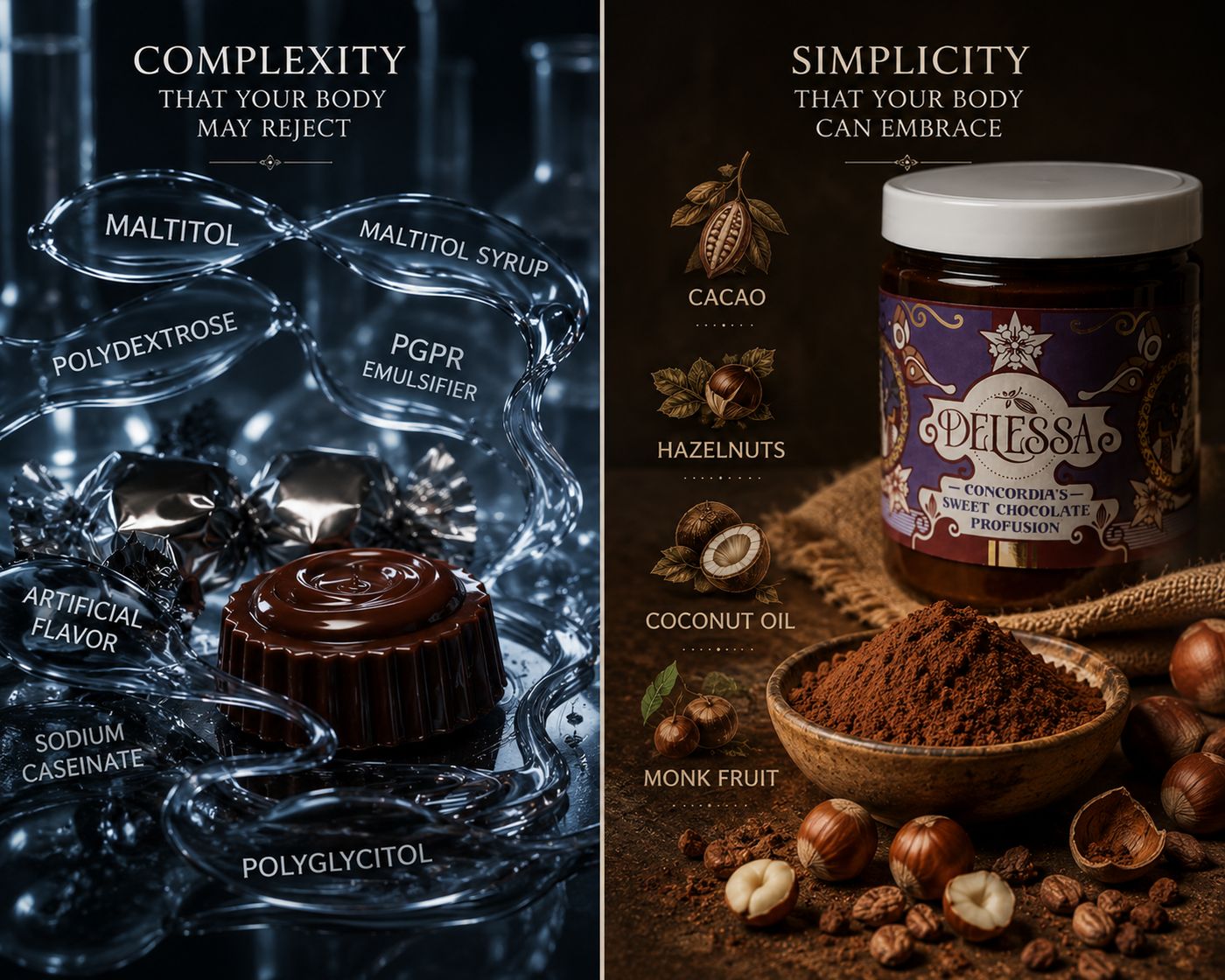
What else is on the list? Maltitol rarely appears alone. Industrial emulsifiers, synthetic bulking agents, and artificial flavors are common companions — added to compensate for the textural and flavor shortcomings of a heavily processed sweetener.
Check the net carb math. Not all sugar alcohols are created equal. Erythritol is often subtracted entirely from net carb counts; maltitol, given its absorption rate, should not be.
More content like this, delivered to your inbox.
SubscribeThe Net Carb Illusion
| Metric (Per Gram) | Maltitol | Table Sugar |
|---|---|---|
| Glycemic Index (GI) | 35 (powder) to 52 (syrup) | 60 to 65 |
| Estimated Glycemic Load (eGL) | 0.35 (powder) to 0.52 (syrup) | 0.60 to 0.65 |
| Calories | 2.1 to 2.5 calories/gram | 4.0 calories/gram |
| Digestion Rate | Partially absorbed (roughly 50%) | Fully absorbed (100%) |
| Gut Sensitivity Trigger | Causes gas & bloating) | Feeds bad bacteria and yeast; Disrupts protective lining of intestines; Can cause digestive discomfort |
Many sugar-free chocolates advertise low net carbs on the front of the package. The math looks simple: take total carbohydrates, subtract the maltitol, arrive at a number close to zero. It’s a compelling claim — and for some sweeteners, it’s legitimate.
For maltitol, it isn’t.
Erythritol passes through the body largely unabsorbed, so subtracting it from net carb counts is defensible. Maltitol is absorbed at roughly 50% — meaning your body processes a significant portion of it as a slow carbohydrate. The calories count. The glycemic impact counts. Subtracting it entirely from your carbohydrate total is misleading math.
To put it in concrete terms: maltitol delivers approximately 2 to 2.5 calories per gram compared to sugar’s 4 calories per gram. That’s not zero. And with a glycemic index of 35–52, it isn’t a freebie sweetener. A product with 20 grams of maltitol will produce a real, measurable effect on blood sugar — not a flat line.
For anyone managing diabetes, a candida protocol, or strict carbohydrate targets, treating maltitol as a zero-impact ingredient is a fast track to unexplained spikes and frustrating results.
The front of the package is a marketing decision. The back is the truth.
A Different Approach
The bar for “sugar-free” has been set by products that technically qualify under that claim while still delivering glycemic impact and digestive consequences for many people.
At Delessa, we built our spread around chocolate — then added a touch of pure monk fruit extract. Not because it’s trendy, but because it’s one of the few sweeteners with no caloric value, no glycemic impact, and no known digestive side effects. It isn’t a sugar alcohol — Delessa contains no sugar alcohols of any kind.
Four ingredients. No shortcuts.
Delessa is crafted by Chef Stef — created over twenty years ago as a matter of survival, with one goal: chocolate that doesn't ask you to compromise. No refined sugar, no palm oil, no sugar alcohols. Just four whole-food ingredients.
The Bottom Line
Maltitol is not a villain — it’s a manufactured ingredient doing exactly what it was designed to do. But if you’re navigating real dietary restrictions for health reasons, you deserve more than what the label offers. Knowing what maltitol is, how it behaves in the body, and why it’s in the products it’s in is what makes the difference between a label-guided choice and a truly informed one.
Wondering how other chocolate spreads handle sweeteners? See how 17 brands compare →
Delessa
Delessa spreads are made with just four ingredients: a raw nut butter base (almond, hazelnut, or coconut butter) raw cacao, virgin coconut oil, and pure monk fruit extract.
25% off, automatically applied at checkout.
